2026-11-09 09:00:42
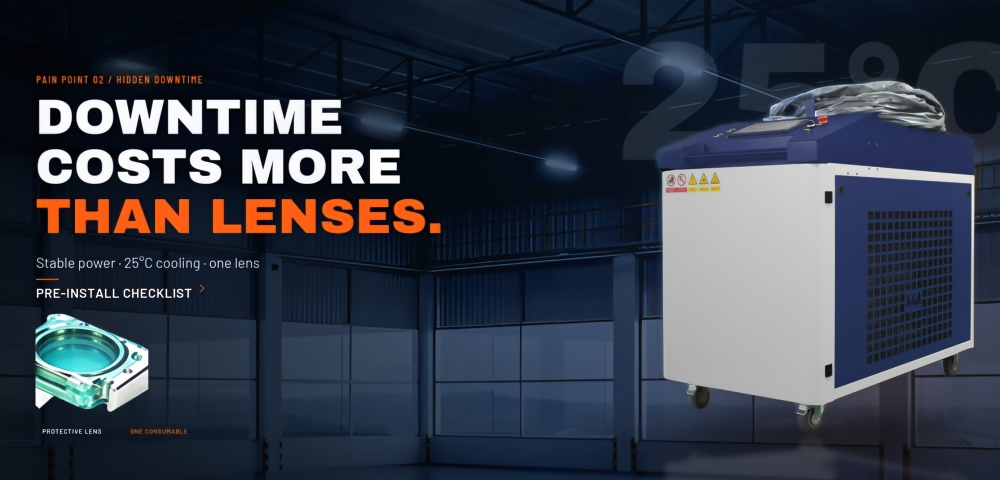
The purchase order lists the laser, the chiller, the cleaning head and the warranty. It rarely lists the three things that decide whether the machine is still producing in month twelve: the quality of the power feeding it, the stability of the cooling loop, and the condition of a lens that costs less than a dinner for two.
Power quality: the failure mode nobody budgets for
The manual is direct: power interruption is very harmful to the laser, and the machine needs a continuous, reliable supply. A 6 kW-class cleaner is not a hand tool that happens to be on a cart. It is a production machine with a laser source, a chiller, a control cabinet and a hand-held head, and all of them share the same supply.
A voltage sag, a lost phase or a breaker trip does more than stop the beam. It can trip the laser, leave the chiller pump restarting against a hot loop, and stress the laser module. Repeat that often enough and the failure shows up as an electronic fault weeks later, far from the event that caused it.
The practical minimum is a dedicated circuit sized to the nameplate, a breaker rated for the inrush, correct cable cross-section, and a reliable protective earth. Surge protection is cheap insurance; a voltage stabiliser is worth considering where the grid fluctuates or where a generator is the primary source. Do not share the circuit with welders, large compressors or other high-inrush loads. Avoid extension reels and adaptors.
The manual also warns against opening panels or connecting and disconnecting electrical lines while powered. Those are not only safety rules; they are the difference between a service call and a warranty discussion.
Cooling: 25°C is a process parameter
The chiller setpoint is 25°C, and the laser should not be started until the loop reaches it. That is not a comfort setting. It is the temperature at which the laser's thermal design is stable, and cleaning performance, lens life and alarm behaviour all depend on it.
The cooling loop has three common failure paths. A blocked exhaust or a cabinet pushed against a wall raises the chiller's condensing temperature until the high-temperature alarm trips. A kinked or flattened 6 mm hose drops flow until the flow alarm trips. Scale, biofilm or low water level reduces heat transfer slowly, without an alarm, until the laser derates or the lens runs hot.
The manual's water rules are worth repeating: distilled or pure water, not tap water; check the whole circuit for leaks at first start; replace the water every two to four months; use antifreeze and keep the chiller running 24 hours a day when the ambient temperature is between -10°C and 0°C; drain the system before long storage. The manual gives two months in one chapter and three to four months in another; on a clean, sealed loop, two to four months is a workable range, with water quality and duty cycle deciding where in that range you land.
Ambient conditions matter too. The specified operating range is 5–40°C and below 80% RH. Keep the cabinet's ventilation openings clear, leave space for the exhaust, and do not install the unit in a sealed container or a corner with no air movement. In a 35°C workshop, a chiller that is undersized or badly ventilated will run at its limit all shift. The laser may not fail, but the machine will alarm or derate.
The protective lens: the cheapest part with the most expensive failure
The manual is unusually clear: the protective lens is the main consumable, and there is no other consumable. That is good news for operating cost and bad news for anyone who treats the lens as an afterthought.
The failure chain is predictable. If the protective gas is off or the pressure is low, the plume from the cleaning point deposits on the lens. The deposit absorbs laser energy, heats locally, and burns through. The focus shifts, cleaning weakens, and the operator raises power to compensate. More power means more heat and more plume, and the next lens fails faster. By the time the laser or the focusing optics are damaged, the cost has moved from a consumable line to a repair line.
The gas specification in the manual is specific: oil- and water-free compressed air at no less than 0.5 MPa, filtered through three or more stages, or nitrogen/argon for oxidationsensitive materials. The regulator is set around 0.3 MPa at the head. Check for leaks and hissing at every connection. A lens that fails far earlier than your log average is usually a gas, standoff or plume-direction problem, not a lens problem.
Keep three to five lenses in stock, log the replacement date and the reason, and inspect the lens at the start of every shift. The lens is designed to be the sacrificial part. When the laser or the focusing optics become the sacrificial part, the economics change by an order of magnitude.
A maintenance calendar that fits a real shift
The table below turns the manual's requirements into a routine an operator can actually follow.
| Interval | Task | What it prevents |
| Before each shift | Water level and temperature (25°C), gas pressure (≥0.5 MPa), lens visual, red light, emergency stop | Most alarms before they stop production |
| Weekly | Clean cabinet intake filter, inspect hoses for kinks and wear, check grounding, log lens hours | Overheating, flow loss, electrical fault |
| Monthly | Check water quality, lens holder seal and nozzle cleanliness; review alarm history | Slow degradation that never reaches an alarm |
| Every 2–4 months | Replace cooling water with distilled or pure water | Scale, biofilm, blocked passages |
| Winter (below 0°C) | Antifreeze; keep chiller running 24 h | Frozen loop, cracked components |
| Long idle | Drain cooling water | Corrosion and damage on restart |
The three-line cost model
Operating cost is easier to argue when it is reduced to three lines.
Line 1 — Energy. Read the nameplate kVA, not the laser wattage. A 6 kW Laser Cleaning Machine includes the chiller, controls and optics, so the input is higher than 6 kW. Multiply the actual draw by your tariff and duty cycle.
Line 2 — Consumables. Protective lenses, water and filters. No grit, no chemicals, no waste disposal. This is the line that makes laser cleaning attractive against blasting and chemical methods.
Line 3 — Downtime. One unplanned hour on a bottleneck cell usually costs more than a year of protective lenses. That is the number to manage, and it is the number the maintenance calendar protects.
Cheap consumables are not the same as low operating cost. Uptime is the operating cost.
Pre-installation checklist
Most warranty conversations start with an installation detail. Check these before the machine arrives.
| Item | Requirement | Why it matters |
| Floor space | 1420 × 730 × 1220 mm, 284 kg, clearance for vents, cable and chiller access | Heat removal and service access |
| Power |
Dedicated circuit, nameplate voltage, PE grounding, correct breaker and cable, surge protectio |
Protects the laser and the electronics |
| Air | Dry, oil-free, ≥0.5 MPa, three-stage filtration | Protects the lens and the cleaning quality |
| Water | Distilled or pure water, 25°C setpoint | Stable thermal performance |
| Environment | 5–40°C, <80% RH, ventilated, fire extinguisher within reach | Rated operation and fire safety |
| Spares | 3–5 protective lenses, spare water, gas filter | Avoids a shift lost to a consumable |