Can a 6000W Handheld Laser Cleaner Replace Sandblasting? What It Can and Cannot Do


2026-11-08 09:28:56


A common starting point for this decision is a 6 mm steel plate with tight rust in the middle and two coats of epoxy at the edges. The buyer asks two questions. First: "Will 6000W be fast enough?" Second, usually after a quote arrives: "Will it damage the plate?" The honest answer to both is that wattage is only half the story. How the energy is delivered — scan width, travel speed, overlap and dwell time — decides the result

What 6000W actually changes

Wattage is headroom, not a speed rating. The 6000W class machine in this manual delivers its power through a 20–500 mm scan width and a scan speed of 1,000–40,000 mm/s. Those two numbers, more than the laser label, determine how much energy lands on each square centimetre of the part.

For a given spot size, energy per unit area rises with power and falls as the beam moves faster or the track gets wider. A 6000W source lets you hold the same energy density while running faster or covering a wider track. That is where the throughput comes from. It is also why a 6000W machine can be gentler than a 2000W machine on a thin part: the extra power is spent on speed, not on dwell.

The benefit is most visible on thick, tightly bonded layers — mill scale, heavy rust, multiple paint coats and large surfaces. On light surface oxidation, a 2000–3000W machine may reach the same visual result with a lower power draw and a lower capital cost.

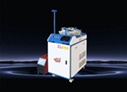
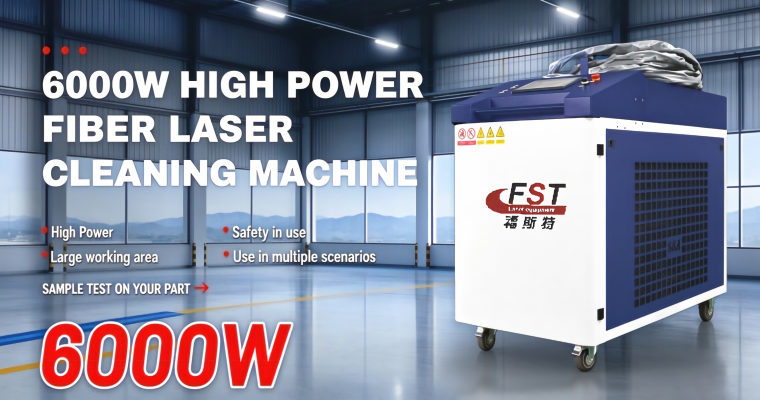
The form factor also matters. This is a floor-standing, water-cooled cabinet: 284 kg, 1420 × 730 × 1220 mm, with a hand-held head. It moves on castors, but it is not a backpack unit. Plan the work area around the cabinet, the chiller, the cable run and the gas supply.


Where laser cleaning wins — and where it does not

Laser cleaning removes rust, mill scale, oxide, paint, coatings and release agents without blasting media, chemicals, masking or a waste stream. It can be aimed at a weld seam or a repair area and leave the rest of the surface untouched. The manual lists automotive, aerospace and electronics as typical fields, and those applications share a common trait: the surface is accessible to a beam.

It is less useful where the problem is not on the surface. Laser cleaning removes corrosion products; it does not rebuild metal that corrosion has already taken away. Deep pitting, undercut edges and crevices may still need mechanical preparation or welding after cleaning. Very thin sheet, reflective surfaces and blind holes also need a different approach or a different tool.

A useful rule: laser cleaning is a surface process. It removes what sits on the metal; it does not restore what the metal has lost.

Will it damage the substrate? Four variables

The manual describes laser cleaning as non-destructive, and that is true within a parameter window. Four variables decide whether the window is wide or narrow.

Variable 1 — Energy density. Power divided by spot area and travel speed. Too much energy per unit area melts or tempers the surface; too little leaves the coating.
Variable 2 — Dwell time. Hand speed is the most variable input in a manual process. Halving the speed doubles the energy delivered to the same point.
Variable 3 — Overlap. Narrow tracks with insufficient overlap leave stripes. Excessive overlap re-heats the same strip and builds heat.

Variable 4 — Coating-to-substrate contrast. Rust and paint absorb very differently from bare steel, aluminium or stainless. A setting that removes paint may mark the metal underneath.

Thin sheet is the least forgiving case. Heat tint on stainless, colour change on aluminium and distortion on 1 mm sheet usually come from dwell, not from wattage. A 30-second test on the actual part is worth more than a page of specifications


A five-step sample test before you buy


The only reliable way to answer "will it work on my part" is to run the part. A structured trial takes less than an hour and prevents an expensive mistake.


Step 1 — Send real parts. Three parts, not polished coupons. Include the worst geometry, the thickest coating and the thinnest section.


Step 2 — Define acceptance in writing. A visual grade such as ISO 8501-1 Sa 2½ for rust, remaining coating on a tape test, roughness Ra if painting follows, and no heat tint or distortion.


Step 3 — Measure before and after. Micrometer readings at marked points, surface profile, and a coating adhesion test if the part will be painted.


Step 4 — Run a small matrix. Three power levels, three hand speeds and two overlap settings. Record cycle time per part, including handling and repositioning.


Step 5 — Check the consumable and the cooling. Lens condition, gas pressure at the nozzle, and chiller temperature after 30 minutes of continuous work.


A supplier who cannot return a parameter report from your samples is selling a cabinet, not a process


When 6000W is the right size — and when it is not
The table below is a starting point for the sizing conversation, not a substitute for a trial.
Application 2000–3000W 6000W
Light rust or oxide on thin sheet Usually sufficient; lower heat risk Overkill; heat management becomes the constraint
Heavy mill scale or thick epoxy on ≥6mm plate Slow; multiple passes likely Preferred; speed and width do the work
Weld seam cleaning before or after welding Adequate for most seams Faster, but the benefit is narrower
Large area, high duty cycle, fixed takt time Marginal Preferred
Limited power supply or small breaker Simpler to install Needs industrial three-phase supply; verify nameplate
Low utilisation, budget-first Preferred Higher capital cost, harder to justif


Most 6 kW Laser cleaning machine are built for three-phase industrial power. The required voltage and current are on the nameplate; they should not be inferred from the laser wattage. Have an electrician confirm the supply, breaker, cable and grounding before the machine arrives.

6000W is a throughput tool. It buys speed on thick coatings and wide areas. It does not buy tolerance for poor technique, and it does not replace a sample test. If your bottleneck is a thick, large part and the site can support the power, cooling and floor space, the 6000W class is the right conversation. If your work is light oxidation on thin sheet, a smaller source will often give a better finish and a better return.
Send a representative part to Foster Laser. We will return a trial report with cycle time, substrate condition, lens condition and a parameter recipe for your material.


Message

Click or drag a file to this area to upload.
 

Privacy Statement

© Copyright 2021 FosterLaser

leave messages