2026-11-10 09:30:20
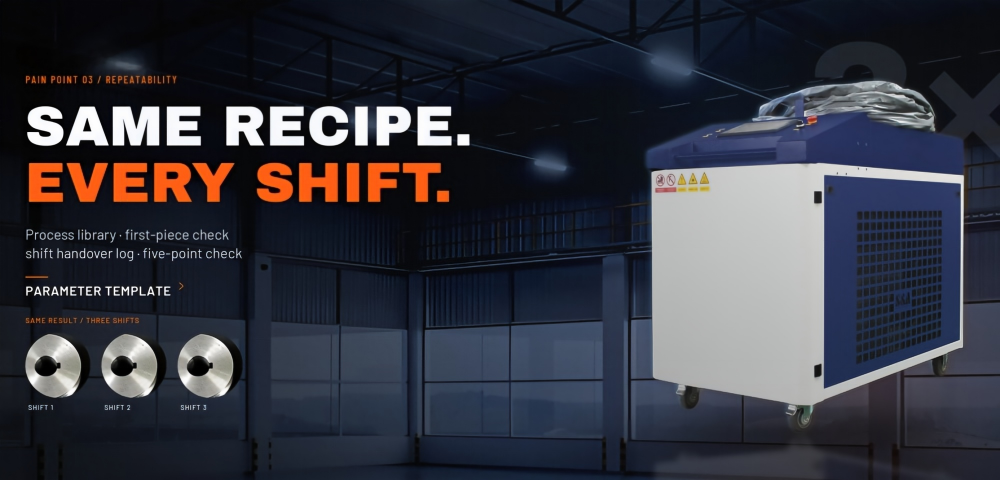
Two shops run the same 6000W cleaner on the same part. One gets a consistent finish and a stable cycle time. The other gets heat tint on Monday, missed paint on Wednesday and a burned lens on Friday. The difference is rarely the operator. It is whether the process exists outside that operator's hands.
Why 6000W magnifies operator differences At 6000W, the energy window is narrower in hand terms. A small change in standoff, angle or travel speed moves the energy density enough to change the result. A 3000W machine forgives a hesitant hand; a 6000W machine records it.
The manual's own numbers show how many variables are in play: scan speed from 1,000 to 40,000 mm/s, scan width from 20 to 500 mm, plus power, frequency, duty cycle, swing speed and swing length. The manual also asks the operator to keep the nozzle-to-plate distance steady and the hand speed uniform. That is good advice. It is not yet a process.
Training that consists of "watch me and try" transfers a feeling, not a process. A process needs a name, a written parameter set, an acceptance criterion and a photo of a good part.
A four-step recipe method
The aim is to find the lowest energy that removes the coating in one pass, then lock that setting. Higher energy is not better; it is just closer to the substrate damage threshold.
Step 1 — Fix the geometry. Set the standoff for the focus lens on the head, hold the head at 90° ± 10°, and use a roller guide or a spacer on flat parts. Mark the direction of overlap so two operators produce the same track.
Step 2 — Set width and overlap. Start with a track that matches the feature, not the widest possible setting, and use 30–50% overlap as a first trial. Wider tracks spread heat; too much overlap stacks it.
Step 3 — Find the minimum effective energy. Start fast and low, then increase power or reduce speed until the coating clears in one pass. Back off 10–15% and inspect for heat tint, discoloration, a visible track or substrate loss. That back-off is what protects the part.
Step 4 — Lock and name the recipe. Name it by material, coating, thickness and track width, for example "Carbon steel / tight rust / 80 µm / 40 mm track". Save it in the process library, attach before-and-after photos and record the gas pressure and lens hours at approval. A recipe without a name and a photo is a rumor.
Make it repeatable across shifts
The control panel supports the routine. The 10-inch touchscreen has a process area for saving and recalling common parameters, a diagnostic page for lens temperatures, input and output states and alarm history, and a status bar for safety lock, laser, galvo, air pressure, chiller and lens alarms. Use those functions as part of the standard work, not as a troubleshooting afterthought.
A one-page work instruction is enough for most cells. It should carry the recipe name, a photo of the accepted surface, the acceptance criterion, the gas pressure, the lens inspection point and the emergency stop location. Laminate it at the machine.
Run a first-piece check at every shift start and after every lens change: red light centred, test patch on scrap, lens visual, water at 25°C. Record the result. This is a two-minute routine that catches most of the problems that turn into a whole-shift scrap event.
Where the part family justifies it, a simple linear slide or rotary positioner removes handspeed variance better than any training slogan. For repair and field work, the hand-held head is the right tool, and the recipe plus the first-piece check carry the consistency.
Where the part family justifies it, a simple linear slide or rotary positioner removes handspeed variance better than any training slogan. For repair and field work, the hand-held head is the right tool, and the recipe plus the first-piece check carry the consistency.
Keep the roles clear: operators own recipe execution and first-piece checks; engineers own recipe creation and approval. Asking an operator to invent a recipe on a 6000W machine is how heat tint and burned lenses enter the process.
Safety and compliance are part of repeatability
A process that depends on the operator remembering to wear goggles is not a process. The machine contains a Class IV fibre laser: invisible, intense, and dangerous even by diffuse reflection. Protective glasses, heat-resistant gloves, a clean work area, a 4 kg or larger fire extinguisher and a strict "never leave it running unattended" rule belong in the work instruction, not in a drawer.
The control system already exposes the key interlocks: safety lock status, clamshell alarm, air pressure, chiller alarm and lens temperature alarms. Treat an alarm as a stop signal, not a nuisance to be cleared. The manual's alarm logic and lens temperature thresholds are there to protect the optics before they fail.
For import and EHS review, the manual states CE, RoHS, FDA and RCM compliance for the product. Keep the declarations with the shipment documents, and make sure the site's risk assessment covers the actual installation: reflections, fume extraction, fire load and electrical protection.