2026-03-03 00:24:04
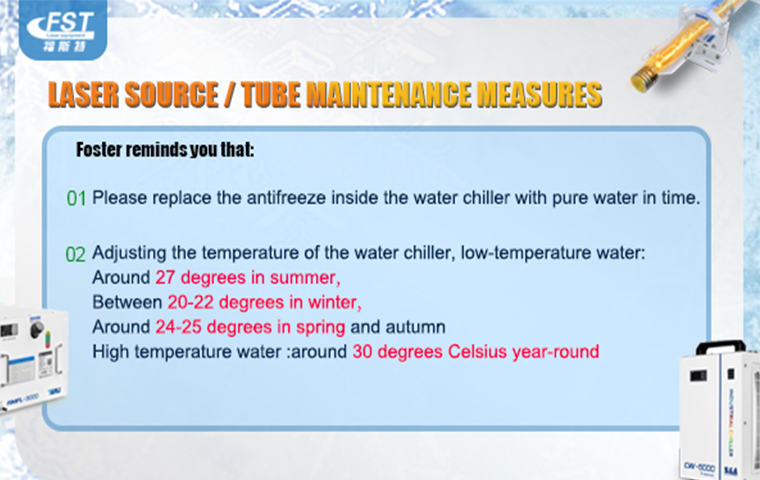
During winter, adding antifreeze to the chiller system is a necessary measure to protect laser equipment from freezing damage under low-temperature conditions. However, as ambient temperatures rise, continuing to use antifreeze as the long-term cooling medium may negatively affect equipment performance and service life.
With the arrival of spring, replacing antifreeze with purified water or deionized water is a standard maintenance procedure that should not be overlooked for any laser system.
Why Must the Cooling Medium Be Replaced as Temperatures Rise?
1. Antifreeze Is Designed for Low-Temperature Protection Only
The primary function of antifreeze is to lower the freezing point and prevent ice formation within the water circulation system. Its main components typically include ethylene glycol or propylene glycol, along with corrosion inhibitors.
When used long-term under normal temperature conditions, antifreeze may lead to:
✅Reduced heat exchange efficiency, affecting cooling performance
✅Increased pump load and accelerated seal aging
✅Residue or sediment formation over extended operation
✅Higher risk of internal contamination within the cooling circuit
For laser systems that require stable output and high-precision control, antifreeze is not an ideal long-term cooling medium.
Standard Cooling Medium: Purified Water or Deionized Water
Under normal operating temperatures, chillers are recommended to use:
✨RO (Reverse Osmosis) purified water
✨DI (Deionized) water
These water types offer the following advantages:
📌Free of mineral ions
📌No sediment or scale formation
📌Low electrical conductivity for enhanced system safety
📌Reduced risk of contamination to the laser source and cooling loop
⚠ Tap water, groundwater, or mineral water must not be used.
Calcium and magnesium ions present in untreated water can easily form scale deposits, which may reduce cooling efficiency and even trigger system alarms.
Water Quality Management Is Critical for Stable Laser Output
The internal cooling circuit of a chiller includes metal pipelines, flow sensors, pumps, and heat exchangers. Poor water quality can result in:
🔔Increased electrical conductivity
🔔False sensor alarms
🔔Fluctuating cooling efficiency
🔔Unstable temperature control of the fiber laser source
Many equipment issues are not caused by power instability, but by inadequate cooling system maintenance.
Clean water is essential —
but using the correct type of water is even more important.
Recommended Replacement Procedure
1.Shut down the equipment and disconnect the power supply
2.Completely drain the existing antifreeze from the system
3.Flush the cooling circuit once with purified water
4.Refill with fresh purified water or deionized water
5.Check water level, flow rate, and alarm status
For high-power systems or complex cooling circuits, it is advisable to have the procedure performed by qualified technicians.
A Simple Maintenance Action Ensures Year-Round Stability
The chiller is the thermal control core of any laser system.
The condition of the cooling system directly affects:
💎Laser output stability
💎Cutting or welding quality
💎Laser source lifespan
💎After-sales maintenance costs
Adding antifreeze in winter is protection.
Replacing it with purified water in spring is responsibility.
Professional laser equipment management starts with attention to detail.
👉 Interested in learning more about our laser cutting, welding, or cleaning machines? Feel free to contact Us:+86 15314155887—he’s ready to provide expert guidance and the ideal solution for your needs.